
One of the key elements of processor setup is the bass management feature. That is the part where you tell the processor whether you have 'small' or 'large' loudspeakers. But what do those settings actually do?
A 'small' speaker in this context means that it is bass limited. Bass limited is how we refer to speakers that cannot play the deep bass frequencies typically associated with larger cabinets. 'Small' speakers generally will not extend below 80Hz.
The crossover setting is the filter applied to these speakers to ensure they are not sent bass energy they cannot reproduce. Most manufacturers will quote a frequency response for their speakers, and it is the low frequency end of that measurement we are most interested in, typically somewhere between 35Hz and 100Hz for cinema speakers.
What happens to the bass energy that gets filtered out? It is not discarded. Instead, it is redirected to the LFE channel and from there to the subwoofer or subwoofers. Which raises a fair question: if nothing is thrown away, why bother with the large setting at all? Why not simply run small speakers throughout, send all the bass to the subwoofer and be done with it?
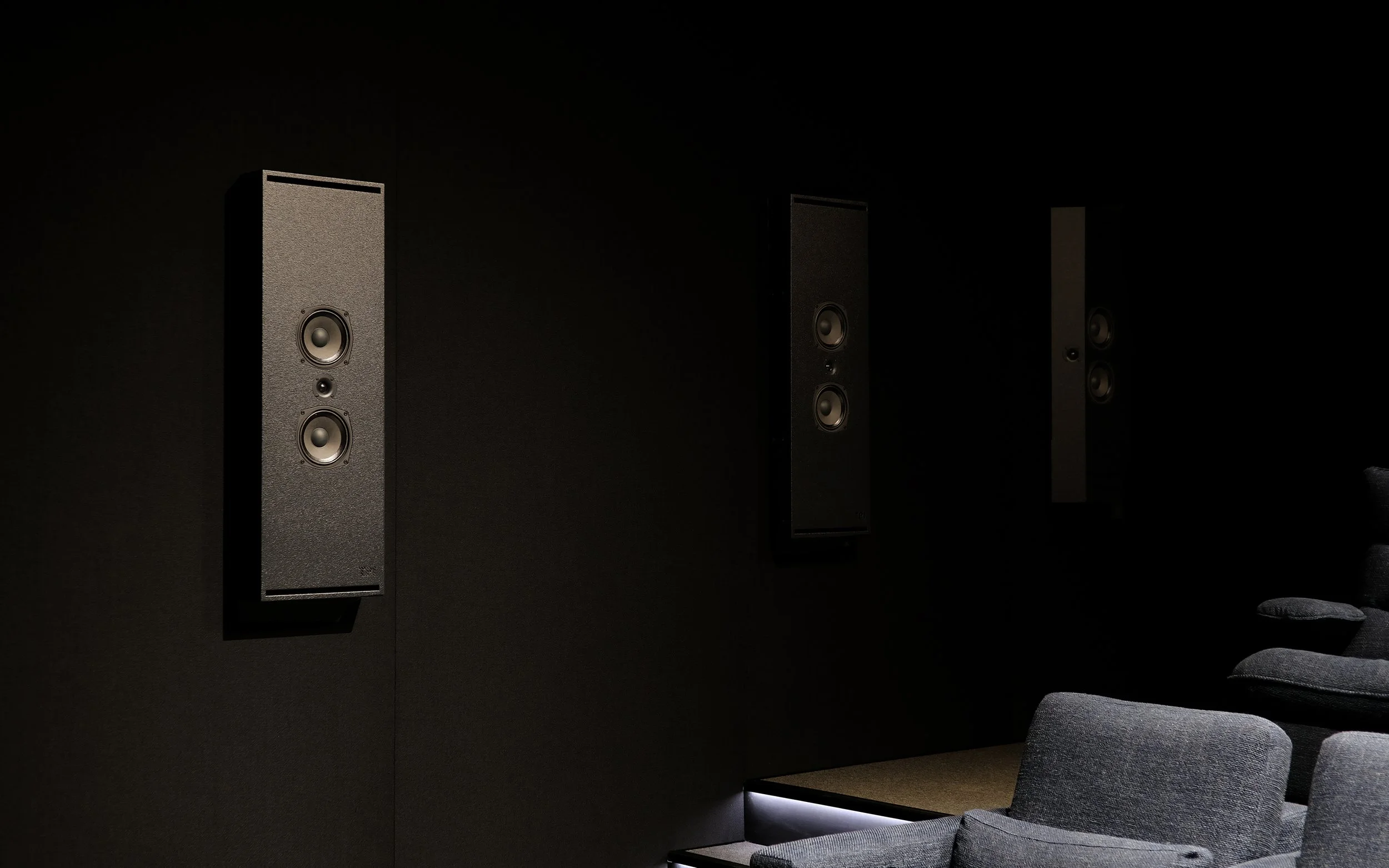
There are actually several good reasons to run large speakers in a cinema, particularly if they have plenty of power and headroom.
Just as you would use multiple subwoofers to break up standing waves, having bass reproduced from multiple points around the room produces a more even response and less variation from seat to seat.
In the best systems I have heard, running large, full range speakers always sounds considerably more natural and cohesive. Part of the reason is that the brain does not have to guess where the bass is coming from. Without bass redirection, you get a much better sense of scale, power and precision in the low frequency range. The other benefit is that it frees the subwoofer to focus purely on the important '.1' channel in multichannel soundtracks. Freed from the responsibility of redirected bass, the subwoofer gains headroom and precision. And having low bass energy entering the room from multiple locations helps to overlap the standing waves and reduce variation across different listening positions.
We are still quite sensitive to bass directionality in the 80Hz region, even if we do not consciously identify it as such. Running full range speakers where possible removes that ambiguity entirely.
In practice, that leaves a couple of realistic options. The first is to simply specify large, full range speakers throughout the bed layer of the audio system. This is not always achievable, as large speakers typically require a mounting depth in excess of 500mm, and that is not always available in the build.
The second option is to pair each in-wall speaker with a dedicated in-wall subwoofer. This is a genuinely elegant solution that creates multiple full range channels within a much slimmer mounting depth. That configuration allows you to run full range LCR and surround channels throughout the bed layer, assuming the budget supports it, delivering a considerably more realistic audio experience with proper panning of bass energy around the room.
And of course, you should still plan for a subwoofer or four to handle the LFE channel.
If you would like some support specifying a cinema system, get in touch with the AV8 team and we can work through the details with you.